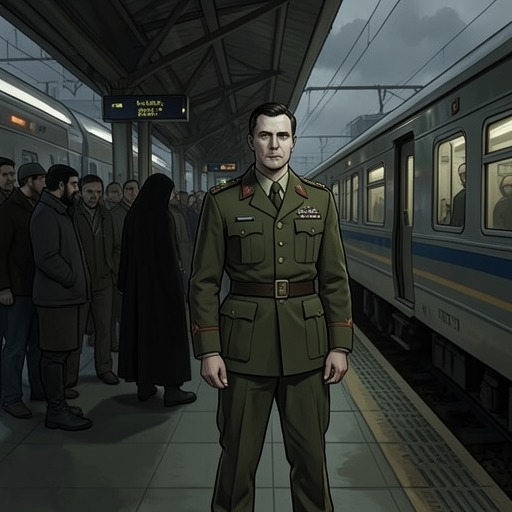
Poe’s court-martial and dismissal from the Army
The Pale Blue EyeEdgar Allan Poe’s court-martial and dismissal from the Army end his West Point career through deliberate, escalating nonattendance rather than a sustained defense before the tribunal. His departure is both a disciplinary outcome he sought and the beginning of an uncertain, impoverished journey beyond the Academy.
The Campaign of Nonattendance
Landor learns the story from the regulars at Benny Havens’ Red House. Sometime after the Christmas holiday, Poe began missing French and mathematics, church and class parades, roll call, and guard mounting. He ignored every order to appear, turning absence into a quiet campaign against West Point. The list’s accumulation makes the defiance systematic: he did not merely skip a particular duty but withdrew from nearly every routine by which the Academy could command his presence.
Court-Martial and Dismissal
Within two weeks, Poe had obtained the court-martial he wanted. He offered almost no defense and was dismissed from the service of the United States that same day. The account presents the proceeding less as a reversal he tried to prevent than as the result his sustained disobedience had been designed to bring about. His minimal defense completes that refusal to rejoin the institution even at the point when it formally determines his status.
Departure and Uncertain Prospects
Poe told Benny Havens that he intended to go to Paris and petition the Marquis de Lafayette for an appointment in the Polish army. The ambition stood in sharp contrast to his immediate means: when he left West Point, he had only twenty-four cents, and he had given Benny Havens his last blanket and most of his clothing to settle his bar bills. His last reported ride was a lift from a teamster bound for Yonkers; the account confirms that he got away from the Academy, not that he reached Paris or obtained an appointment.
The Story Left Behind
The regulars also preserved an unverified tale about one of Poe’s final days at the Academy. Supposedly ordered to drill armed and in crossbelts, he appeared on the Plain naked except for the required arms and crossbelts. Benny Havens interpreted the display as showing off; Landor speculated that it might have been an argument against imprecise language, while doubting the story because Poe could not abide the cold. The anecdote is explicitly hearsay, not a confirmed incident, but it extends the image of Poe’s departure as a final, theatrical refusal to meet West Point’s expectations.